
The 2026 AP Automation and Payments Technology Advisor Report – Built for How AP Actually Works
The AP automation and payments technology market has never been more crowded or more confusing. Over the past decade, the number of providers has exploded, solution boundaries have blurred, and new claims around “AI-powered” capabilities are announced faster than most AP teams can reasonably evaluate them. That complexity is precisely why Ardent Partners has just published the 2026 AP Automation and Payments Technology Advisor, our most comprehensive evaluation of the market to date.
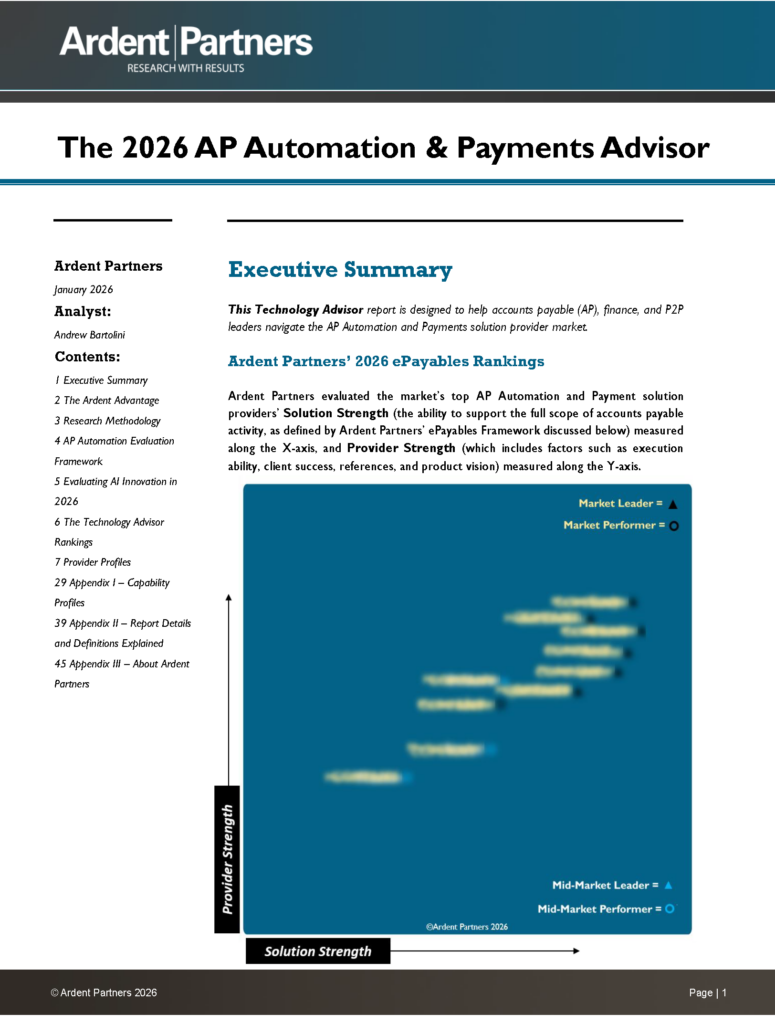
This report does include a quick visual reference but it is also a deeply analytical, highly practical guide built to help AP and finance leaders understand how these solutions actually work, where they differ in meaningful ways, and what those differences mean when selecting technology to support real-world AP operations.
Built on Depth, Not Abstraction
Ardent Partners analysts bring decades of hands-on experience evaluating, implementing, and advising on AP technology and processes. That experience matters. AP automation is not a generic software category; it is a discipline defined by document flows, controls, compliance, exceptions, and trade-offs between automation and accountability. Understanding those nuances requires sustained, specialized coverage.
Many market evaluations today reduce complex solutions into solitary, abstract scores or broad positioning with little explanation of why providers landed where they did or how buyers should interpret those results. In contrast, the AP Automation Technology Advisory pairs quantified scoring with clear narrative context, explaining the evaluative criteria, the underlying capabilities, and the architectural and operational implications behind every assessment.
There is no magic in this report. We believe buyers deserve transparency, so we explicitly define what we evaluated, how we evaluated it, and why certain capabilities matter more than others depending on organizational size, structure, and priorities.
Explaining the Differences That Actually Matter
This year’s report evaluates providers across 32 capabilities, grouped into six solution categories spanning invoice automation, payments, supplier management, platform architecture, user experience, and most critically, AI innovation. Rather than treating AI as a marketing checkbox, we assess it in context: where it is embedded in AP workflows, how much autonomy it enables, how transparent its outputs are, and how ready it is for production use today.
We are genuinely excited about the potential AI brings to AP, but we are also realistic. The market is still early in the innovation cycle, particularly around predictive, generative, and agentic capabilities. Our analysis reflects that maturity curve, rewarding practical, proven intelligence while avoiding hype-driven conclusions. In several of the most advanced AI areas, no provider was awarded a “Leader” ranking and that restraint is intentional.
The result is a report that helps readers distinguish between solutions optimized for control versus autonomy, mid-market versus enterprise complexity, global compliance versus regional depth, and innovation roadmaps versus production-ready capability.
A Practical Guide for Real Buying Decisions
The AP Automation Technology Advisory is designed to be used, not just read. It is a guide that AP and finance leaders will rely on to frame RFIs, build shortlists, challenge vendor claims, and align technology choices with operational realities. With more than 200 providers in the broader market and only 10 evaluated in depth, inclusion in this report reflects both relevance and rigor.
At its core, this report exists to explain a complex solutions market with clarity and fairness helping buyers make better decisions and helping providers understand how their offerings are perceived when evaluated through an AP-first lens.
The report published today and is accessible here.