

[Editor’s Note: Today’s article is a guest post from Joseph R. Postiglione Sr., CPSM, a procurement executive, transformation leader, consultant, and executive coach with more than twenty years of experience helping organizations improve commercial performance, operational effectiveness, and business outcomes. His experience includes serving as Chief Procurement Officer for the National Basketball Association (NBA) and leading large-scale transformation initiatives across multiple industries. If you or someone you know would like to make a guest contribution, please contact us at editor at cporising dot com. Thanks!]
“A successful implementation creates operational capability. It does not ensure that the expected business value used to justify the investment will ultimately be realized.”
Organizations do not invest in artificial intelligence because they want AI. They invest because they expect business value.
The business case may promise improved productivity, reduced operating costs, cost avoidance, better decisions, improved compliance, risk reduction, or revenue growth. Regardless of the specific objective, those expected outcomes become the reason leadership approves the investment. Once the investment is approved, implementation begins.
Project plans are developed. Technology is configured. Integrations are built. Testing is completed. Users are trained. Adoption programs are launched. Eventually, the solution goes live.
At that point, many organizations make assumptions that deserve closer examination. They assume that successful implementation and successful outcome realization are essentially the same thing. They are not. An AI solution can be implemented successfully, users can adopt it, workflows can operate correctly, and performance dashboards can remain green while the expected business value that justified the investment gradually weakens.
The implementation may be successful. The business case may not be. Understanding that distinction is becoming increasingly important as organizations invest more heavily in AI-enabled initiatives.
Every Significant AI Investment Begins with Expected Outcomes
Every significant AI investment begins with expected outcomes. Those outcomes may include savings, productivity improvements, cost avoidance, growth opportunities, risk reduction, compliance improvements, or better decision-making. They are the reason the investment exists.
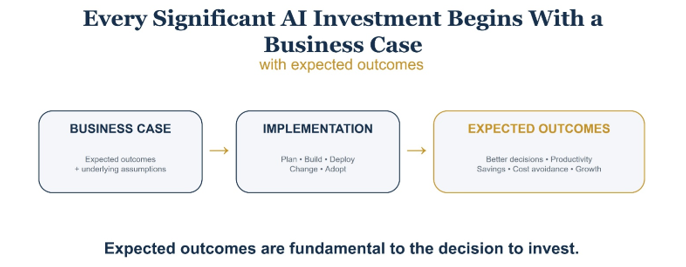
Before implementation begins, leadership develops a business case built on assumptions regarding both benefits and costs.
Expected benefits may include:
- Labor efficiencies
- Cycle-time improvements
- Better decisions
- Reduced risk
- Improved compliance
- Revenue growth
Expected costs may include:
- Software licensing
- AI token consumption
- Infrastructure
- Professional services
- Integration expenses
- Human review activities
- Change management
- Ongoing support
Together, they establish an expectation: Estimated Business Value = Estimated Benefits − Estimated Costs. This equation represents the value executives expect to receive when approving the investment. It also establishes a benchmark against which future performance should be evaluated.
Traditional Implementation Delivers Capability
Traditional implementation methodologies are highly disciplined. They bring rigor to planning, configuration, development, testing, training, governance, deployment, and adoption. Their purpose is to ensure the organization receives the capability it purchased. That discipline remains essential.
However, there is an important distinction. Traditional implementation methodologies were designed to deliver operational capability. They were not designed to continuously manage the business outcomes that justified the investment after go-live.
Implementation success answers one question: Did we successfully deploy the capability? Executive leaders eventually ask a different question: Are we realizing the business value that justified the investment? These questions are related but not identical.
An organization can achieve the following while simultaneously producing weaker-than-expected business outcomes:
- Successful deployment
- Strong user adoption
- Stable operations
- Positive performance metrics
Implementation is a point-in-time event. Outcome realization is a continuous condition, where savings may fail to materialize; productivity gains may never translate into measurable value; and support costs may exceed assumptions. This also doesn’t account for changing business conditions or weakening economic climate.
Without a formal outcome-management discipline, management often relies on dashboards, reports, business reviews, and human assessments to understand performance. While these mechanisms provide visibility, they do not necessarily provide control.
Most dashboards answer what is happening. However, leadership increasingly needs a capability designed to explain what is not happening and why. Without that capability, organizations frequently recognize value erosion only after it appears in financial results, operational reviews, or executive escalations.
Should an Investment Ever Be Left to Chance?
Organizations do not approve investments hoping expected outcomes will occur. They approve investments because expected outcomes are believed to be achievable. Yet after go-live, many organizations rely primarily on operational reporting, periodic reviews, and management observation to determine whether expected outcomes are actually developing.
This raises an important question: Should an approved investment ever be left to chance? If expected outcomes justified the investment, should management not possess a capability specifically designed to continuously evaluate whether those outcomes remain achievable?
Leadership should not be discovering outcome deterioration after value has already been lost. Management should possess the capability to continuously monitor the conditions influencing expected outcomes, identify emerging risks, and understand when intervention may be required while meaningful response options still exist.
Organizations routinely design controls to protect budgets, security, compliance, quality, and operational performance. Expected business outcomes deserve the same discipline. The objective is not eliminating uncertainty; it’s ensuring uncertainty is actively managed rather than passively discovered.
That is the gap Commercial Control was designed to address.
To Manage Outcomes After Go-Live, Design for Them Before Go-Live
One of the most important lessons from successful outcome management is surprisingly simple: If organizations want to manage outcomes after go-live, they must design for outcomes before go-live.
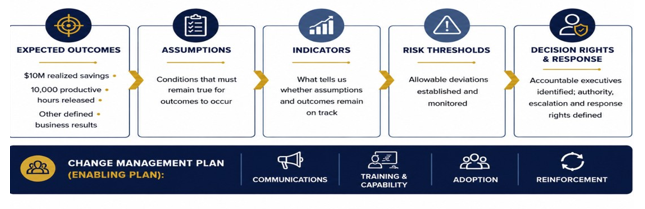
Using an Understanding by Design (UbD) approach, implementation planning should begin with the intended business outcome and work backward from there. The first question should not be what technology are we implementing? But rather, what business outcome are we trying to achieve?
Once outcomes are defined, organizations can identify:
- The assumptions supporting success
- The conditions required for success
- The indicators that reveal change
- The thresholds requiring intervention
- The accountability owners responsible for outcomes
- The escalation mechanisms required when conditions change
- The decision rights required to respond
These activities should receive the same level of discipline traditionally devoted to architecture, integrations, testing, training, security, and deployment planning. Outcome realization should not be assumed; it should be designed.
Commercial Control
Commercial Control was developed to address this challenge. It is a management capability designed before go-live and operated after go-live to keep expected business outcomes visible, actionable, and continuously managed throughout the operational life of an initiative.
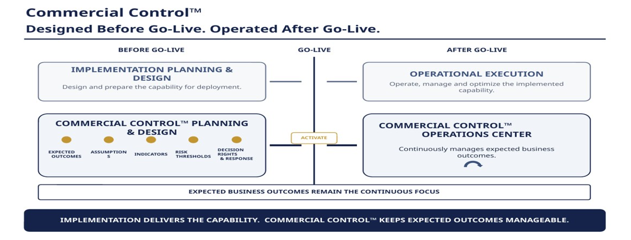
Commercial Control does not replace traditional implementation methodologies but complements them and helps keep expected outcomes manageable. Before go-live, organizations establish: Estimated Business Value = Expected Benefits − Expected Costs. After go-live, attention shifts to: Net Business Value = Realized Benefits − Realized Costs. Commercial Control provides the management capability required to continuously compare the two.
Its purpose is straightforward: To determine whether the outcomes that justified the investment remain achievable, economically viable, and aligned with executive expectations.
How Commercial Control Works in Practice
Commercial Control becomes operational when the technology becomes operational, with its purpose going beyond monitoring activity to include continuously evaluating outcome realization health. At a high level, the operating model follows a simple progression: Monitor → Detect → Evaluate → Escalate → Assess → Respond.
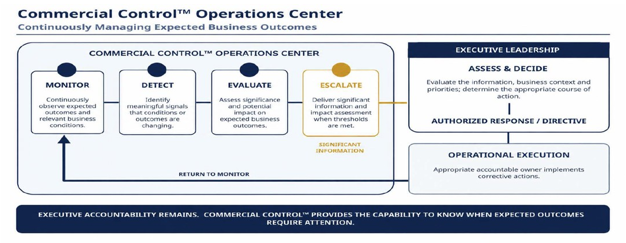
This capability provides management with visibility into:
- What outcomes are not developing
- Why outcomes are not developing
- Which assumptions have changed
- Whether value remains achievable
- What corrective actions remain available.
Without Commercial Control, management often relies on historical reporting to explain what happened. With Commercial Control, management gains visibility into whether expected outcomes remain achievable while meaningful corrective options still exist.
From Estimated Business Value to Net Business Value
No business case perfectly predicts the future, nor does an implementation plan perfectly anticipate changing conditions. This is precisely why the objective is not perfect prediction but rather continuous evaluation. Commercial Control helps organizations understand the relationship between estimated business value and net business value.
This comparison reveals:
- Which assumptions proved accurate
- Which assumptions changed
- Where expected value is developing
- Where expected value is weakening
- Whether intervention is warranted.
Rather than assuming value realization, organizations can actively manage it.
What CPOs and CFOs Should Do Differently and Expect Their Implementation Partners to Deliver
If expected outcomes are the reason investments are approved, then outcome realization should be considered an implementation deliverable rather than an operational afterthought.
Technology deployment alone should not be the sole measure of implementation success.
Executive sponsors should expect implementation partners to deliver Commercial Control as part of the implementation itself. The organization should receive not only the deployed technology capability, but also the management capability required to continuously understand whether the business value used to justify the investment remains achievable after go-live.
Too often, implementation plans are designed to deploy technology successfully while leaving outcome realization largely to chance. The assumption is that if the technology works, the outcomes will naturally follow. We should not depend upon what they do sometimes.
The issue is not whether implementation teams successfully deployed the capability, but whether leadership possesses the visibility necessary to continuously understand if expected outcomes are developing as anticipated and, if not, why not.
Before approving an AI investment, for example, CPOs and CFOs should require implementation partners to clearly explain how expected outcomes will be monitored, evaluated, governed, and managed throughout the operational life of the initiative.
Key questions include:
- What expected outcomes justify the investment?
- What assumptions must remain true for those outcomes to occur?
- How will expected benefits be measured?
- How will expected costs be measured?
- How will outcome realization health be evaluated?
- What indicators signal that expected outcomes are becoming at risk?
- What conditions should trigger escalation?
- Who owns intervention authority?
- How will management know what outcomes are not developing and why?
- What capabilities will remain after implementation is complete?
Implementation partners should be expected to deliver more than deployed technology. They should deliver:
- Commercial Control
- Outcome management design
- Outcome governance structures
- Accountability models
- Executive visibility mechanisms
- Commercial visibility mechanisms
- Outcome realization indicators
- Escalation procedures
- Intervention frameworks
- Commercial Control operating procedures
Most importantly, implementation partners should demonstrate how management will continuously answer a question that becomes increasingly important after go-live: Are we still achieving the outcomes that justified the investment? If the answer depends primarily on quarterly reviews, periodic reporting, or leadership eventually discovering a performance gap, the implementation remains incomplete.
Organizations routinely design architecture, integrations, security controls, governance models, training programs, and deployment procedures before implementation begins. They should apply the same discipline to expected outcomes.
Because technology deployment is not the end of the investment lifecycle. It is the point at which outcome realization begins.