
Supplier management is no longer simply an operational procurement function. It has become a strategic capability that directly influences cost, resilience, and business performance. As procurement leaders navigate ongoing market volatility, geopolitical uncertainty, and accelerating AI adoption, they are placing greater emphasis on supplier visibility, performance management, and risk intelligence.
Rather than treating supplier information, sourcing, contracting, and purchasing as separate activities, leading organizations are connecting them into an integrated operating model that provides a complete view of supplier relationships across the entire Source-to-Pay lifecycle. This shift enables procurement teams to move beyond reacting to supplier issues and toward proactively managing performance, mitigating risk, and creating long-term value.
Ardent Partners research shows that integration (not simply automation) is the key differentiator. While many organizations continue to rely on fragmented systems and manual processes, those with integrated supplier management consistently outperform their peers across procurement’s most important metrics, including realized savings, contract compliance, supplier enablement, and operational efficiency. Just as importantly, integrated supplier data creates the trusted foundation required for AI to deliver meaningful business outcomes. As procurement enters the next phase of digital transformation, organizations that invest in connected supplier management will be best positioned to leverage intelligent automation, strengthen supplier collaboration, and make faster, more informed decisions in an increasingly unpredictable business environment.
Based on Ardent Partners’ recent research report and webinar of the same name, “Supplier Management: The Integrated Advantage,” featuring Andrew Bartolini, Chief Research Officer for Ardent Partners; Ken Miklos, Senior Director Product Marketing for SAP; and Sami Mrad, Regional Procurement Manager for Sonae Arauco, here are six ways that integrated supplier management leads to wins in procurement.
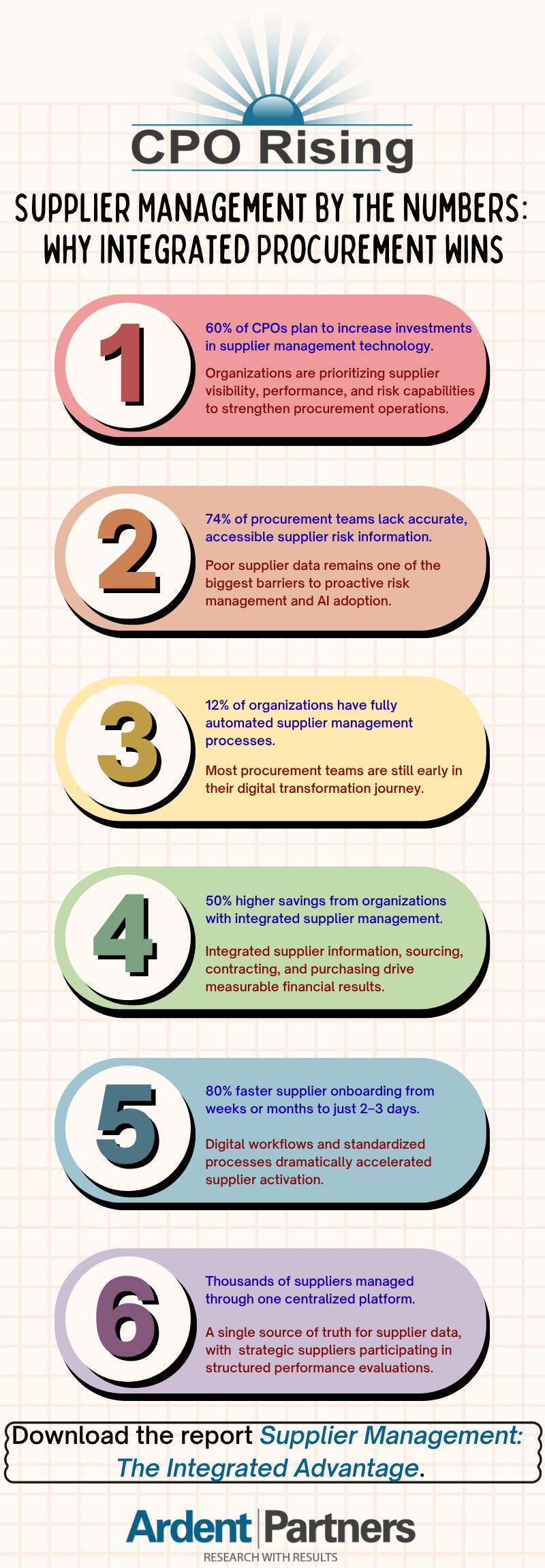
- 60% of CPOs plan to increase investments in supplier management technology. Organizations are prioritizing supplier visibility, performance, and risk capabilities to strengthen procurement operations.
- 74% of procurement teams lack accurate, accessible supplier risk information. Poor supplier data remains one of the biggest barriers to proactive risk management and AI adoption.
- 12% of organizations have fully automated supplier management processes. Most procurement teams are still early in their digital transformation journey.
- 50% higher savings from organizations with integrated supplier management. Integrated supplier information, sourcing, contracting, and purchasing drive measurable financial results.
- 80% faster supplier onboarding from weeks or months to just 2–3 days. Digital workflows and standardized processes dramatically accelerated supplier activation.
- Thousands of suppliers managed through one centralized platform. A single source of truth for supplier data, with strategic suppliers participating in structured performance evaluations.
Organizations that integrate supplier management across the Source-to-Pay lifecycle achieve greater savings, stronger supplier performance, better risk visibility, and a scalable foundation for AI-driven procurement.