
The Carrousel du Louvre, a place synonymous with timeless masterpieces, served as the backdrop last month for a different kind of evolution: the rapid transformation of the procurement function. At Ivalua NOW 2026, the theme was “Shaping New Horizons,” but the subtext for the 1,500 CPOs and procurement leaders in attendance was clear: We have officially moved past the AI hype phase and entered the era of Agentic Procurement.
The New Global Standard: A Mandate for Agility
The backdrop to the event was unmistakably macroeconomic. CEO Franck Lheureux opened the session by acknowledging that procurement leaders are operating in a “new phase” of global business defined by geopolitical flashpoints, talent scarcity, and rising cyber threats. Rather than positioning these forces as temporary disruptions, Ivalua framed them as structural shifts that require a new global standard of operation.
The message to the CPOs in the room was empowering: Your job in procurement has never been harder, but your impact has never been greater. In this high-stakes environment, legacy models, characterized by fragmented systems and siloed data — are no longer sufficient. Organizations must instead build resilience through connected and adaptive operating models.
The Big Pivot: From “Help Me” to “Do This For Me”
Unsurprisingly, AI dominated the main stage agenda, but the conversation moved decisively from experimentation to execution. Founder and Chief AI Officer David Khuat-Duy described the fundamental shift in the technology “under the hood.” We are transitioning from the world of Generative AI (where a chatbot might “help me write this email”) to the world of Agentic AI (where an intelligent agent can “do this for me”).
To power this transition, Khuat-Duy announced the launch of IVA Studio. This is not just another feature to the suite, but instead, a sophisticated, no-code development environment that serves as the “factory” for an organization’s agentic workforce. High-level, IVA Studio enables procurement teams to build, orchestrate, and govern custom AI agents called “skills” grounded in their own reliable S2P data and files. These skills appear as templates designed to complete an action or activity. This shift from “copilot” to “co-worker” represents an evolution toward systems that move beyond passive assistance to actively executing tasks and augmenting strategic decision-making. My next article covering this event will do a dive deep into the Studio, what it will offer, and how it works.
The Blueprint: Three Systems for Effective Enterprise AI
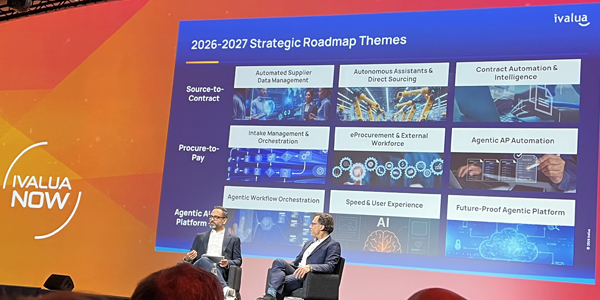
Ivalua’s roadmap for 2026 and 2027 is built on a specific architecture designed to ensure that AI doesn’t become “a shiny tool on a cracked foundation.” For AI to be effective at the enterprise level, it must be supported by three interconnected systems:
- Systems of Record: This is the foundation of data mastery. As Khuat-Duy noted, your data is the moat; while AI models are becoming a commodity, the unique context of your organizational data is the asset that drives ROI.
- Systems of Action: This represents the interaction between human expertise and intelligent agents. It involves a “Human-in-the-Loop” model where AI replaces the mundane tasks that keep buyers from being strategic.
- Systems of Governance: To reach scale, trust must be earned every day. This system focuses on building, monitoring, and evaluating AI performance with active guardrails and adherence to schema constraints to prevent hallucinations.
Ardent Analysis: Why the Strategy Resonates
From an analyst perspective, Ivalua enters this “Agentic Era” with significant momentum. The company reported $235 million in revenue for 2025 with 24% ARR subscription growth. Perhaps more impressively, they maintain what they defined as a 110% customer retention rate, with 70% of their base already migrated to the latest platform version.
This level of customer stability is critical when asking an organization to move toward autonomous processes. Because Ivalua has maintained an organic, unified platform for 25 years, they avoid the “integration debt” that often plagues suites built through aggressive M&A.
For the CPO, this means a more reliable path from AI potential to measurable value.
Paris proved that the technology is ready and the roadmap is clear. The question now is how quickly procurement teams can evolve their culture and data foundations to keep pace with these new horizons.
Next in the Series: We take a deep dive into IVA Studio to look at the specific “Skill Library” that will power the autonomous procurement workforce.