
The Seat Is Dead: Why AI Is Forcing a Fundamental Rewrite of Software Economics
AI is not just changing how work gets done, it is redefining what enterprises pay for. As software shifts from enabling human effort to executing work autonomously, procurement leaders must rethink pricing models built for a pre-AI world.
The Seat Is Dead: The Great Software Rewrite
For two decades, enterprise software pricing followed a simple rule:
More users = more value = more revenue.
AI just broke that equation.
The Core Shift: From Supporting Work to Being the Labor
Traditional SaaS augmented humans. CPOs paid per seat because humans did the heavy lifting.
But AI is no longer a tool; it’s becoming a digital employee.
- It doesn’t just “help” process an invoice; it resolves it.
- It doesn’t just “enable” a sourcing event; it executes it.
And critically:
It does all of this without adding users.
In fact, the better the AI, the fewer users you need.
Which creates a structural problem:
👉 The legacy pricing model penalizes the very innovation customers are buying.
The Paradox
The better the AI performs, the fewer “seats” you need. Legacy pricing now penalizes the very innovation you’re trying to buy.
This is not a pricing tweak.
It’s a model failure and something must change
What Replaces It: The New Units of Value
We are watching, in real time, the emergence of three new pricing models:
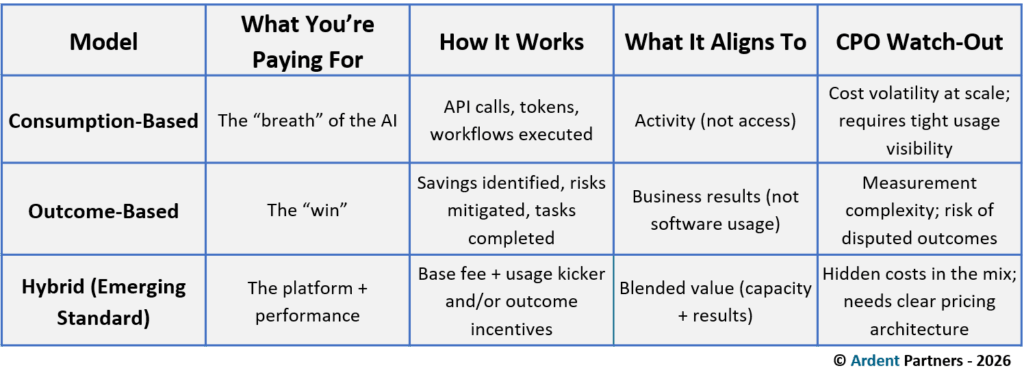
These emerging AI software pricing models – consumption, outcome, and hybrid – are reshaping how procurement evaluates value. This is where things get interesting… and negotiable.
Why This Matters for CPOs (Now)
This is not just a vendor-side evolution. This is a once-in-a-decade procurement reset.
CPOs have the leverage to stop paying for “access” and start paying for “impact.”
But beware: Unlike SaaS, AI has high marginal costs (compute/inference). Solution providers cannot give you “unlimited” usage forever without hitting a margin wall.
Negotiation in 2026 and beyond will be about balancing your value against their compute reality.
In short:
👉 Procurement moves from cost control to value design.
The Hidden Constraint: AI Economics Are Not SaaS Economics
There’s a catch, and it’s a big one.
AI is not high-margin, near-zero marginal cost software.
Every AI action has a real cost:
- Compute
- Model inference
- Infrastructure
Which means:
- Vendors can’t blindly offer unlimited usage
- Margins compress as adoption scales
- Pricing models must balance value delivered vs. cost incurred
This tension will define the next wave of vendor innovation and CPO negotiation.
Because inference costs are real, CPOs must watch out for ‘hidden’ pass-through costs in contracts that look like flat fees but have usage caps buried in the fine print.
The Strategic Implication
We are entering a world where:
- Software is no longer sold as a tool
- It is delivered as labor, capacity, and outcomes
And that changes everything:
- How vendors build
- How CFOs forecast
- How procurement buys
The Bottom Line
The seat is not just declining, it’s becoming irrelevant.
AI is forcing a shift from:
- Paying for who uses the software
➡️ to
- Paying for what the software actually does
The organizations that understand this early, on both sides of the table, will define the next generation of enterprise value.