LevelUp 2026: How Levelpath (and Its Customers) Are Rewriting the Procurement AI Playbook (Part 1)
This article is the first of two that discusses Levelpath’s inaugural LevelUp 2026 conference held in San Francisco on March 4 and 5 at the Contemporary Jewish Museum and highlights several of the conference’s keynote addresses.
LevelUp 2026: Guess Who’s Back, Back Again
Earlier this month, in San Francisco, Levelpath hosted its inaugural LevelUp conference, bringing together customers, partners, and procurement leaders to explore what an AI-native procurement future might actually look like in practice.
For me, the event carried a sense of déjà vu, in the best possible way.
Back in 2018, I attended Spark, the first user conference hosted by Scout RFP. At the time, I wrote that the company had managed to “catch fire” with a community-driven energy that felt different from the traditional procurement technology circuit. The co-founders, Stan Garber and Alex Yakubovich, weren’t just launching a new software company, they were already building a movement around modern, pragmatic sourcing.
Although it was an early stage company, these leaders already had momentum and the buy-in of dozens of Chief Procurement Officers. Less than two years later, they had the literal buy-in of Workday.
Seven years later, watching them take the stage, this time as co-founders of Levelpath, I had the same feeling. They seem to have captured lightning in a bottle, again.
LevelUp 2026 felt less like a typical enterprise software conference and more like the early stages of a community rallying around a new model for procurement, this time built on the foundations of AI, automation, and intelligent agent workflows. And judging by the product announcements and customer stories shared throughout the event, that vision is already starting to take shape.
Co-Founders Keynote: A Company Built in and for the AI Era
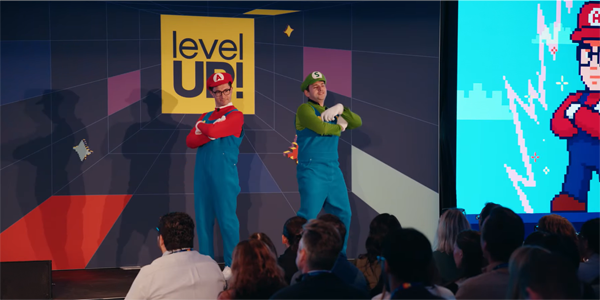
Yakubovich and Garber opened the conference dressed as Luigi and Mario and high-fived their way into a sweeping keynote that combined a company update, a reflection on the state of AI, and a roadmap for the future of procurement technology.
Levelpath itself has grown quickly since launching just a few years ago. The company now has roughly 160 employees (known internally as “Pathfinders”) and has raised $100 million in funding to build what the founders describe as the “only AI-native procurement platform.”
But the founders were careful to emphasize that their vision isn’t simply about adding AI features to existing workflows.
Instead, they said that Levelpath was designed from the ground up to rethink procurement software entirely.
The platform brings together a full suite of procurement capabilities, including intake management, sourcing, contract lifecycle management, supplier management, and pipeline analytics, into a single system of record built around modern user experiences.
Garber described this as a platform designed around “delightful applications” a phrase that resonated with many attendees who have spent years navigating clunky legacy procurement systems.
Among the key platform components highlighted during the keynote were:
- Dynamic intake and request management that act as the “front door” for procurement
- Pipeline and project tracking for sourcing initiatives
- Savings tracking and event analytics
- RFx sourcing tools and quick bid capabilities
- Contract management, approvals, and renewal management
- Supplier management and third-party risk capabilities
- A roadmap into procure-to-pay capabilities, including invoicing and payment initiation
Underlying the entire platform is Levelpath’s Hyperbridge AI engine, which serves as the platform’s intelligence layer and powers everything from intelligent search and OCR to workflow automation and AI assistants.
But the most important message from the keynote was that AI is fundamentally changing how procurement work gets done.
“Something Big Is Happening”
Early in the keynote, Yakubovich and Garber referenced a recent article about how AI is quietly reshaping knowledge work across industries.
Their message to the audience was blunt:
“Something big is happening.”
The founders argued that we are still in the early innings of enterprise AI adoption, even though the pace of innovation is accelerating rapidly. In many cases, they noted, the latest generation of AI models is capable of performing entire tasks, not just assisting with them.
For procurement organizations, this raises an important question:
What is your AI plan?
To help answer that question, the founders introduced what they called the AI Playbook for Procurement, built around three key shifts organizations will need to embrace.
- New Skills: Procurement teams will need to develop new capabilities through training, experimentation, and shared learning around AI tools.
- Agent Operations: Organizations will increasingly need individuals responsible for designing and managing AI agent workflows—essentially a new operational role focused on automation design.
- New Metrics: Traditional procurement metrics won’t fully capture AI’s impact. Instead, organizations should track measures such as:
- Percentage of the team using AI tools
- Number of AI-driven workflows deployed
- Number of AI agents in operation
They also also shared a customer example illustrating AI’s potential – one customer was able to reduce contract cycle times from one month to a single day by leveraging automated workflows and AI-driven processes.
The Orchestration Studio Announcement
The centerpiece of the keynote was the unveiling of Levelpath Orchestration Studio, a new capability designed to make AI agent development accessible to procurement teams.
Yakubovich described the system using a simple analogy.
“Think of it like building with Legos.”
Inside the Orchestration Studio, users can design AI agents through a drag-and-drop interface that connects different elements of an automated workflow.
The architecture follows a layered approach:
- Trigger – the prompt or event that starts the workflow
- Context – information such as stakeholders, suppliers, and relevant data
- Instructions – rules, governance requirements, and workflow logic
- Actions – the automated steps executed by the agent
Using a visual node-based menu, procurement teams can combine these elements to create agents that perform tasks such as drafting RFx documents, routing approvals, analyzing supplier proposals, or managing contract renewals.
The goal is to enable organizations to build multi-agent procurement workflows without needing software developers.
If the founders’ message throughout the keynote was that AI will reshape procurement work, Orchestration Studio represents Levelpath’s answer to how organizations can actually operationalize that change.
A new movement has begun!