We recently published our annual Procurement 2026: BIG Trends and Predictions report. It’s a report I’ve been writing for about a decade that distills months of market data, conversations with CPOs, and a deep dive into the ProcureTech labs reshaping our world.
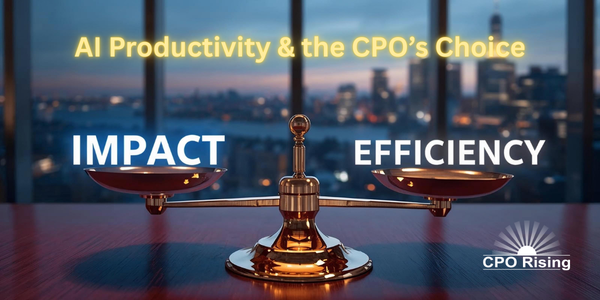
The 2026 report arrives at a moment of filled with great uncertainty, but also, great opportunity. This year, we outlined 33 BIG ideas designed to help procurement pros in every industry and region prepare for a year that will be defined by uncertainty. AI, of course, is a major theme in the report and a major focus for many procurement teams. It is our view that much of the work done on AI in 2026 will start to pay dividends for some organizations in 2027. But while the different AI initiatives take hold and begin to mature at varying speed, inevitably CPOs will be faced with critical choice between efficiency and impact. Despite organizational pressure, I don’t think that choice is so obvious. So, it’s my recommendation that CPOs start planning (and positioning) their post-AI department now.
The Productivity Mirage
Of course the timing will be different for different departments but as AI agents begin to take root and successfully automate what some call the “manual middle” of a procurement operation, a significant productivity dividend will be created. As operational capacity opens up, the CFO and other executives are going to want to see the impact on budgets and calculate an ROI on AI. After all, “if AI is doing the work, why do we need the same headcount?”
The pressure will be real and it will be felt across the entire enterprise. But, there is a danger in moving too fast. Many companies will shoot first and move to cut staff in many departments prematurely, assuming AI can cover the gap. These organizations will hit the “AI Value Gap, “a point where autonomous agents, lacking institutional judgment and historical context, fail to handle complex exceptions.
From a procurement perspective, there has been a ‘generational black swan’ event nearly every year this decade. We should expect the next crisis to be around the corner. If and when that crisis hits, procurement teams that are overly reliant on agents will lack the sourcing savvy and institutional judgment needed to win the day. Consider how valuable your battle-tested sourcing leaders were during the pandemic and inflation and with tariffs … Accept no substitute!! (at least for now).
The immediate opportunity is for CPOs to use AI to elevate their teams, not shrink them. There will be a ton of pressure, but CPOs should not move too quickly to trade human capital for short-term budget wins. Instead, I think there is an opportunity right now get ahead of the AI efficiency narrative and expand the scope and impact of procurement.
Expand the Strategic Frontier
The new report identifies multiple trends that can help CPOs make their case for expansion. These trends look at how the procurement scope has been expanding organically over the past decade and are five critical areas that would benefit from investment:
- Supplier Risk Management as a Core Operating Discipline
Risk has moved from episodic assessments to an always-on, core operating discipline. Today, systems can provide real-time visibility across financial, operational, and geopolitical dimensions, as well as global ESG requirements. There is a realization that in a fragmented world, a supplier’s failure is the buyer’s failure and the customer’s pain. By reinvesting the time saved by AI, teams can move from reactive monitoring to proactive resilience, where risk visibility should be as real time as spend data.
- Category Management Evolves into Category Intelligence
The old model of category management with static spreadsheets, dozens of steps, and annual bids is fading. The industry is moving toward “category intelligence,” that requires staff who can interpret real-time market signals, geopolitical shifts, and internal demand patterns. Leveraging AI can aggregate and synthesize the data, but the team provides the strategy. This standard “turning data into intelligence” story can enable the team to actively manage more categories and place more spend under management. Any CPO worth their salt knows that managing more spend delivers a huge ROI.
- Borderline Chaos: Navigating the Infinite Loop of Trade Conflict
We are no longer in a temporary trade war; we are in an infinite loop of conflict. Tariffs and trade barriers have become standard tools of foreign policy. Managing this requires a deep understanding of total landed costs and local sourcing alternatives. This isn’t a one-time solve; it appears to be a marathon (one without a starting time, a defined route, or finish line). When the TOC changes monthly, sourcing experience is invaluable.
- The Blurring Line Between Procurement and Supply Chain
We predict that in 2026, the line between Procurement and Supply Chain will continue to blur. As Procurement takes on more responsibility for logistics, inventory, and supplier performance, the scope of the “P2P” professional is widening. This expansion requires a team that understands the end-to-end value chain, not just the contract.
The Path Forward – Value Expansion
There will be immense pressure to trim “the middle” part of the organization. These are the staffers who traditionally handled task management. What’s left would be a department of senior leaders and junior staffers. Market analysts have started calling this the Hourglass Job Market.
The “Productivity Dividend” of AI is a once-in-a-generation opportunity to rewrite the procurement mandate. There is a huge opportunity to expand procurement’s scope, deepen its intelligence, and insulate the enterprise from a volatile world. To quote my CPO Rising 2019 (which was subtitled #ValueExpansion):
“To expand value creation in the decade ahead, the modern CPO will need an open and intellectually curious mindset that has the capacity to thoughtfully consider new ideas and actively push them forward. CPOs must follow the courage of their convictions as they start to re-frame the procurement function and how it engages and operates.”
There is a huge opportunity to AI as the catalyst to reimagine and expand procurement’s scope.
For those who want to see the 33 BIG Trends and Predictions, we’ll be sharing a series of short videos that break them down on CPO Rising starting later this week.