
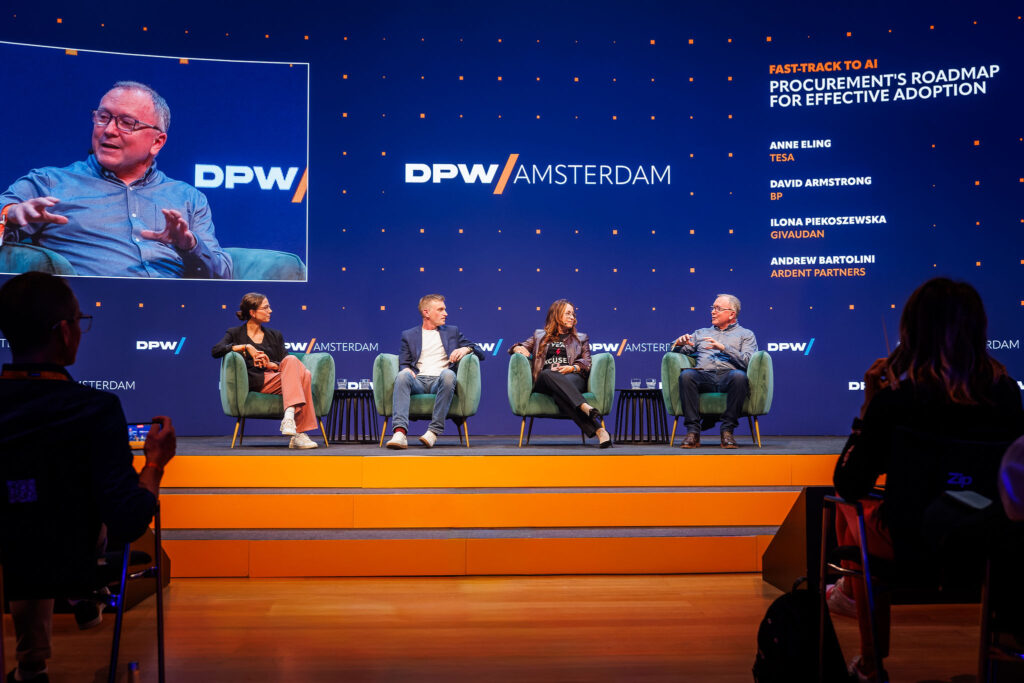
Procurement leaders gathered at DPW/Amsterdam recently to discuss the latest in digital procurement innovation and transformation. Andrew Bartolini, founder and chief research officer for Ardent Partners, moderated the session “Fast-Track to AI: Procurement’s Roadmap for Effective Adoption,” featuring procurement leaders Anne Eling, head of procurement excellence at Tesa, David Armstrong, VP, procurement — strategy and sustainability for BP, and Ilona Piekoszewska, global head indirect procurement (materials and services) for Givaudan.
In the second of a two-part article series, we’re bringing the highlights and key points from this session, along with a link to the event.
As AI becomes the defining technology of the next decade, procurement leaders around the world are grappling with a pivotal question: How do we move fast enough to capture value while still building the foundations needed for sustainable transformation? This is the core tension explored during the panel discussion featuring procurement leaders from Givaudan, BP, and Tesa. Their experiences reveal that while the procurement function stands on the brink of unprecedented capability, the path forward requires not just new tools, but new behaviors, new governance models, and new ways of thinking about procurement itself.
Stories of Scale
The conversation continued with a discussion about establishing scale: Givaudan operates a $4B procurement function; Tesa manages $1B in spend across a dispersed global footprint; and BP oversees a staggering $28B supply chain with 31,000 suppliers and more than 150 warehouses. These numbers aren’t just context, but illustrate the vast diversity of procurement challenges and why AI journeys differ by organization. AI must be tailored to the structure, maturity, and operational realities of each enterprise.
Givaudan. For Piekoszewska, the story at Givaudan began with curiosity. AI tools were emerging rapidly, and while the organization faced growth pressures, complexity, and rising workloads, they didn’t initially have a clear roadmap. Instead, they began experimenting. Running five pilots in a single year without excuses or hesitation created a profound realization: the organization could not go back. Once teams experienced how AI eliminated low-value tasks and freed capacity for strategic work, adoption began accelerating organically. Exploration became conviction.
BP. BP’s story is grounded in scale and fear of falling behind. Armstrong explained that with an ERP transformation underway, and with procurement increasingly recognized as a strategic lever for the enterprise, the company saw AI as a way to avoid stagnation during a multi-year system overhaul. The procurement Digital Garage emerged as both a symbol and a mechanism for innovation. What makes the model powerful is its autonomy: a dedicated team, protected budget, and a mandate to explore, pilot, and scale solutions independently. BP’s approach merges entrepreneurship with structure, with open innovation at the front end and rigorous governance at the back.
Tesa. Eling introduced perhaps the most innovative operational model: the “agent factory.” She discussed how the company’s harmonized global tech stack gave the procurement team a strong foundation from which to build AI agents across three layers. At the simplest layer, teams create their own prompts and lightweight tools to solve everyday problems. The second layer adds more complex, IT-supported agents integrated into internal systems. The third layer consists of enterprise-scale AI solutions that deeply connect into ERP and guided buying processes. This layered model accelerates experimentation, empowers teams, and ensures scalability over time.
Yet despite differing paths, all panelists circled back to the same critical success factor: adoption. AI is not a technology problem; it is a people problem. Teams may fear change, doubt the value of AI, or simply lack time to explore new tools. Eling explained that Tesa combats this through structured learning, an AI ambassador network, monthly deep dives, and even global agent-building competitions.
Givaudan goes further by making AI adoption a KPI, shifting team focus from cost savings to capability building, said Piekoszewska. The effect was transformative. Teams saw firsthand that AI didn’t replace them, but rather amplified them. Armstrong emphasized change accelerators and digital development as core competencies for procurement professionals at BP. Their message was clear: future procurement excellence will depend as much on digital fluency as on category expertise.
Strong Data Foundation and Solution Design
The conversation then moved to data, which represents the foundation on which all AI outcomes depend. Armstrong acknowledged the enormity of managing 45 ERPs and fragmented taxonomies at BP. Their approach: start where the data is clean, build a clear data strategy, and then harmonize progressively. Waiting for perfect data would paralyze transformation. Tesa recognized similar limitations and intentionally pursued process-driven AI use cases first. Those use cases that are not dependent on deep data mining, said Eling. This pragmatic sequencing allows organizations to capture value while strengthening data foundations for more advanced analytics later.
Solution selection revealed another shift in procurement norms. While procurement is accustomed to structured sourcing events, Piekoszewska argued that traditional RFPs often hinder innovation when exploring AI pilots. Instead, co-creation with startups accelerates learning, increases engagement, and allows solutions to be tailored to procurement needs without the burden of customization-heavy legacy systems. Eling added that isolated use cases can only go so far; organizations must gradually transition from experimenting with tools to designing connected, enterprise-level AI architectures.
The panel concluded with reflections on long-term transformation. Quick wins matter because they energize teams, build momentum, and demonstrate value. But sustainable transformation requires looking years ahead, into how AI will reshape processes, data flows, systems integration, supplier ecosystems, and procurement talent models.
The procurement organizations that thrive will be those that operate in two modes simultaneously: delivering value now through lightweight AI and preparing the enterprise for deeper, more structural AI-enabled reinvention. In other words, fast-tracking AI doesn’t mean rushing blindly. It means moving quickly with intention, aligning pilots with strategy, ensuring adoption, building governance, strengthening data, and designing a future-forward architecture.
Procurement leaders must navigate complexity, uncertainty, and competing priorities, but as the panelists illustrated, the greatest risk is not moving too fast; it’s moving without vision.