
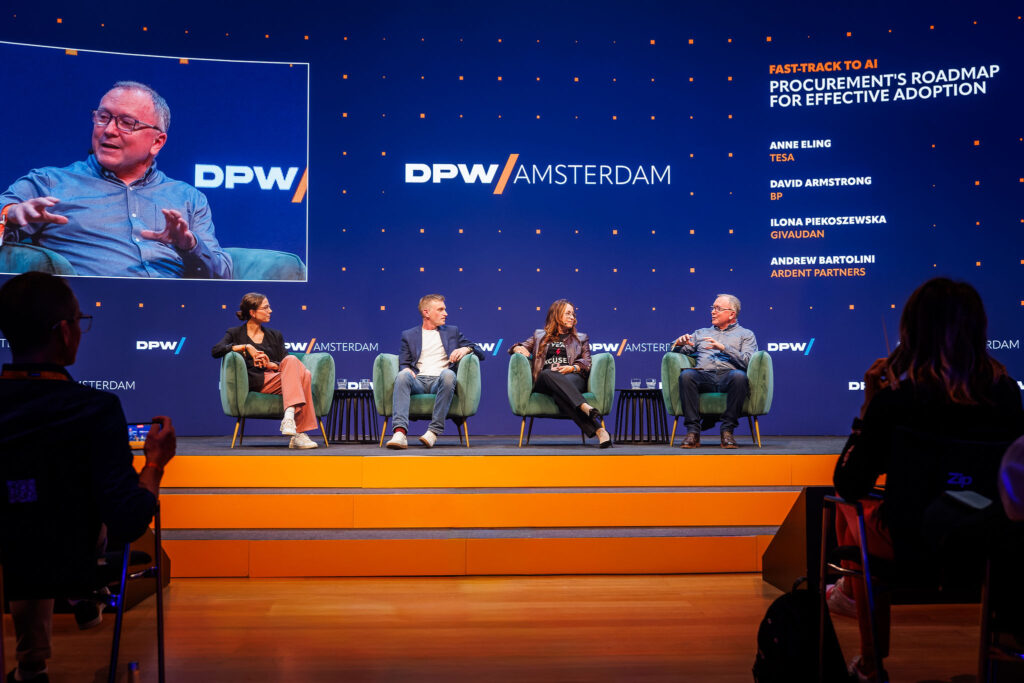
Procurement leaders gathered at DPW/Amsterdam recently to discuss the latest in digital procurement innovation and transformation. Andrew Bartolini, founder and chief research officer for Ardent Partners, moderated the session “Fast-Track to AI: Procurement’s Roadmap for Effective Adoption,” featuring procurement leaders Anne Eling, head of procurement excellence at Tesa, David Armstrong, VP, procurement — strategy and sustainability for BP, and Ilona Piekoszewska, global head indirect procurement (materials and services) for Givaudan.
In the first of a two-part article series, we’re bringing the highlights and key points from this session, along with a link to the event.
Across global enterprises, procurement leaders are feeling the pressure to adopt artificial intelligence — and adopt it fast. But as the panelists at DPW stressed, speed without strategy can backfire. The challenge isn’t simply plugging in AI; it’s orchestrating the right mindset, governance, technology approach, and change infrastructure across diverse and often complex organizations. During the session, moderated by Andrew Bartolini of Ardent Partners, procurement leaders from Givaudan, BP, and Tesa shared candid insights into how they’re getting started, accelerating responsibly, building adoption, and preparing their data and organizations for an AI-first future.
Their stories reveal a common truth: AI in procurement is not just a technology transformation but rather an organizational transformation.
Understanding the Starting Point: Scale, Complexity, and Readiness
Before diving into their AI strategies, the panelists outlined the scope of their organizations:
- Givaudan (flavors and fragrances): €4B annual procurement spend.
- BP: $28B in third-party spend, 31,000 suppliers, 150 warehouses, and 45 ERP systems.
- Tesa (adhesive technology): €1B procurement spend and a global, highly distributed footprint.
These baselines matter because modern AI depends not only on ambition but on the scale of processes, data diversity, and organizational readiness.
Givaudan: Curiosity Turning Into Action
For Givaudan, the shift toward AI began with a simple question: Which technology is the right “fit” and how do we even know? Ilona Piekoszewska compared the experience to selecting a perfume in duty free: multiple great options, but only some suitable for everyday use.
The company ran five AI pilots in 12 months, driven by workload pressure, supply chain complexity, and a need to elevate procurement’s value. Once the team saw the benefits, Piekoszewska noted, “it became impossible to go back.”
BP: The Fear of Falling Behind
BP’s AI journey began two years earlier, driven by ERP transformation fatigue and anxiety over the explosion of new procurement technologies. While the ERP initiatives would take years, AI offered immediate potential. As David Armstrong explained, “We were naturally worried we’d get left behind.” The organization recognized that AI was essential to stay competitive.
Tesa: An AI-First Culture Already in Motion
Tesa had an advantage: a harmonized global tech stack and a leadership team already championing an AI-first mindset. Anne Eling explained that employees were not skeptical — they were eager. With strong executive sponsorship, the organization began generating ideas organically, giving procurement a head start.
How Leading Organizations Get Started with AI
BP: Think Big, Start Small, Scale Fast
Armstrong summarized BP’s approach with one mantra: Think big. Start small. Scale fast.
BP established a Digital Garage, a five-person team with an independent budget, dedicated to:
- Scanning new technologies
- Running proof-of-concepts
- Conducting pilots
- Scaling successful solutions
Key elements included:
- Identify business problems first, not technology first.
- Conduct hackathons to surface operational pain points from frontline teams.
- Use a formal scoring model (i.e., efficiency, impact, and ease of implementation) to determine which problems go into the pilot pipeline.
- Apply structured governance so only vetted solutions “exit the garage” for full deployment.
This disciplined model has resulted in deployments with several leading procurement AI vendors.
Tesa: The “Agent Factory” Approach
Tesa structures AI development into three layers:
- Simple, team-built agents (e.g., SharePoint search agents or automated financial risk checks).
- Mid-complexity agents integrated with existing systems that are developed jointly with IT (e.g., a risk-screening agent pulling from multiple online data sources).
- Enterprise-level tools layered onto the tech stack involving startups, guided buying interfaces, and robust integrations.
The benefit of this tiered approach, said Eling, is continuous learning and adoption, while simultaneously building toward enterprise-level transformation.
Givaudan: Rapid Pilots and Co-Creation
Givaudan emphasizes co-creation with vendors, especially startups. Piekoszewska stressed that procurement cannot rely on rigid RFP processes for early AI exploration. Instead, teams must learn what’s possible through experimentation, not checklists. This approach improves team engagement and accelerates learning.
Driving Adoption: The Hardest and Most Important Part
Regardless of strategy, all leaders emphasized that adoption — not technology — is the hardest part.
Tesa: The Learning Journey and Ambassador Program
Tesa addressed passive resistance through:
- Mandatory global learning journeys
- AI ambassador networks
- Monthly AI calls highlighting new prompts and agents
- Agent development contests to encourage experimentation
This hands-on culture helps employees overcome fear and fuels grassroots innovation.
Givaudan: Shifting KPIs Toward Adoption
After slow early usage, Piekoszewska said that Givaudan changed KPIs from focusing on savings to focusing on technology adoption. The result? A significant shift in behavior and value delivery. Employees realized AI could help them do more meaningful work.
BP: Change Accelerator Squads
BP equipped procurement with digital acceleration ambassadors and change squads. But as Armstrong noted, adoption requires relentless follow-through: “Tools don’t get adopted the next day. It takes a year (or two) of continuous learning, sharing, and reinforcement.”
Data Strategy: The Foundation of Sustainable AI
BP: Tackling 45 ERPs and Fragmented Data
BP’s situation is extreme: 45 ERP systems and inconsistent taxonomies. To improve data readiness:
- Procurement moved under the EVP of Technology.
- A new procurement CTO was appointed.
- Data architects and data scientists now partner directly with procurement.
- A formal data strategy and governance layer is being built.
Armstrong emphasized an important mindset shift: data doesn’t need to be perfect — just “clean enough” to start.
Tesa: Process-Driven First, Data-Driven Next
Tesa began with process-driven use cases, but now recognizes the need for a searchable, harmonized data layer to enable advanced spend analytics and more powerful use cases.
Selecting Technology: Beyond the RFP
Givaudan: Co-Creation Over Checklists
Piekoszewska argued that traditional procurement selection processes don’t work for AI pilots. Instead:
- Start with the business problem.
- Co-create with tech partners.
- Prioritize flexibility over rigid requirements.
- Leverage events like DPW to explore and learn.
Tesa: Moving From Isolated Use Cases to Platform Thinking
After many independent use cases, Tesa is shifting toward an enterprise AI architecture, ensuring:
- Overlapping use cases connect
- Interfaces standardize
- Agents operate across shared platforms
BP: Neutral Vendor Approach, Now Rebalanced Toward Agentic AI
BP typically takes a problem-first, vendor-neutral approach, but Armstrong acknowledged the need for intentionally pushing agentic workflows across procurement.
Balancing Quick Wins With Long-Term Vision
All leaders agreed: procurement needs both rapid experimentation and long-horizon planning.
- Quick wins build credibility and enthusiasm.
- Long bets ensure scalability and enterprise transformation.
- Both create the momentum needed to sustain innovation.
Looking Ahead to 2027: What Procurement Will Become
Givaudan: Teams and Agents Working Seamlessly
Piekoszewska imagines a future where human teams and AI agents operate like an orchestrated Disney experience — fluid, intuitive, and value-generating in real time.
BP: Transparent, Insight-Driven, and User-Friendly
Armstrong described two priorities:
- Procurement practitioners begin their day with clean, orchestrated insights in one place.
- Business users no longer see procurement as a “black box.”
Tesa: Procurement as the Ethical, Innovative Steward of an AI Ecosystem
Eling foresees procurement shifting toward:
- Ethical AI governance
- Oversight of a connected ecosystem
- Continuous innovation
- Faster, smarter, and more integrated operations
AI Is Not a Tool — It’s a Transformation
The procurement leaders agreed on one unambiguous truth: AI in procurement is not about technology alone. It’s about cultivating the right culture, the right data, the right operating model, and the right mindset.
Organizations that learn fast, adopt broadly, and scale wisely will define the procurement function of the future.