
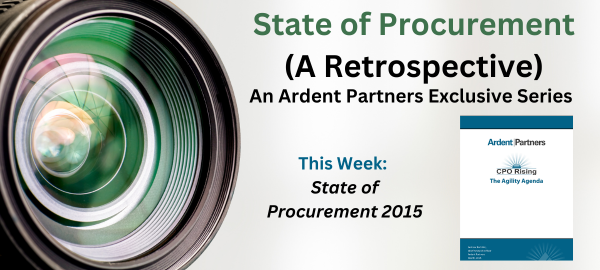
The role and strategic agenda of the chief procurement officer (CPO) have evolved over the past decade. In this ongoing series, we revisit what defined procurement and the CPO’s agenda based on responses to Ardent’s annual State of Procurement survey. The series started in 2006, the year I first tackled the the “CPO Agenda” study. While the report titled evolved with my move to Ardent Partners (the report, like this website is called “CPO Rising”), it has always been a fantastic way to get a deep view into the market and understand what is driving the industry each year.
Each week, I will outline the key procurement insights for the next year in this series, culminating in 2025.
The Evolving Procurement Imperative: Why the CPO Needs a New Agenda in 2015
In today’s volatile, hyper-connected business environment, no enterprise can afford to operate in a vacuum. Competitive pressures, rapid innovation, and growing complexity demand not only internal collaboration but also strong, value-driven relationships across the extended supply chain. A company’s performance can be directly impacted by the decisions, operations, and agility of its suppliers. At the same time, business functions within the enterprise must work more cohesively to optimize results and respond to evolving market demands. At the heart of this convergence is procurement — and its leader, the Chief Procurement Officer (CPO) — increasingly recognized as a key driver of enterprise strategy, agility, and resilience.
As the pace and complexity of global business continue to accelerate, procurement must evolve accordingly. The traditional role of procurement as a tactical, back-office function has long since become obsolete. To remain effective and impactful, procurement departments must transform into agile, insight-driven organizations capable of converting knowledge into strategy and strategy into performance. And for this transformation to occur, the CPO must adopt a new agenda — one that reflects procurement’s expanded scope, influence, and potential.
A Strategic Function Born from Crisis and Innovation
Procurement’s rise to strategic relevance is rooted in history. While the concept of acquiring goods and services is as old as commerce itself, procurement’s emergence as a formal business function took shape during the Second Industrial Revolution. With the dawn of machine-driven, mass production, having the right materials at the right time became essential at scale. Over time, especially after the World Wars, organizations began to shift away from complete vertical integration toward specialized supplier networks, placing increased importance on procurement’s role in managing external relationships.
Still, for much of the 20th century, procurement remained largely clerical. It wasn’t until the latter decades — when business visionaries began to recognize procurement’s strategic potential — that the function truly began to evolve. The internet and B2B technology boom of the late 1990s and early 2000s further accelerated this shift. Companies began pouring billions into digital solutions to streamline purchasing processes, improve spend visibility, and enhance supplier collaboration. Alongside this technological investment came a wave of education (targeted at business leaders) to reframe procurement as a strategic function capable of driving enterprise value.
The Rise of the CPO
One of the most visible outcomes of this evolution was the establishment of the Chief Procurement Officer role. By elevating procurement leadership to the C-suite, organizations acknowledged the function’s growing importance. The CPO role provided procurement with executive visibility, strategic influence, and a seat at the table for broader business decisions. Yet, while the title may be common today, its strategic nature is still relatively new. It was only a decade ago that the idea of a defined “CPO Agenda” began to take hold — focused on transformation, influence, and long-term business impact.
Early procurement strategies centered around cost savings, process efficiency, and compliance. Over time, this agenda has expanded to include risk management, supplier innovation, sustainability, and cross-functional collaboration. Still, as Ardent’s research reveals, many organizations have yet to fully implement the best practices introduced during procurement’s first wave of transformation. The gap between vision and execution remains real — but so does the opportunity.
Procurement at a New Crossroads
The stakes today are higher than ever. Globalization, digital transformation, supply chain disruption, and shifting regulatory environments have reshaped the business landscape. At the same time, new technologies, such as AI, predictive analytics, and cloud-based platforms, are empowering procurement teams with unprecedented data, visibility, and automation. The challenge now is to harness these capabilities in service of enterprise agility and resilience.
CPOs are being asked to do more — faster and with greater precision. Procurement is expected not just to enable savings but to help drive innovation, support M&A activity, enforce compliance, and mitigate risks tied to suppliers, geography, and geopolitical events. As one CPO interviewed for the report put it, “We’re no longer just buying things. We’re enabling the business to grow — smartly, safely, and sustainably.”
The New Agenda: Agility, Insight, and Integration
Going forward, agility will define procurement’s success. The CPO’s new agenda must focus on dynamic responsiveness — being able to pivot quickly without sacrificing control or quality. That means building flexible processes, fostering a culture of innovation, and deploying technologies that enable smarter, faster decisions. It also means strengthening relationships both inside and outside the organization, particularly with suppliers that are critical partners in the enterprise’s long-term strategy.
The future belongs to procurement teams that can connect tools, talent, and insights to support evolving business needs. As Ardent’s report emphasizes, executives will demand more from procurement tomorrow than they did yesterday. Those who embrace this new mandate — grounded in strategy, driven by data, and executed with agility — will not only elevate their function but play a central role in defining the enterprise of the future.