
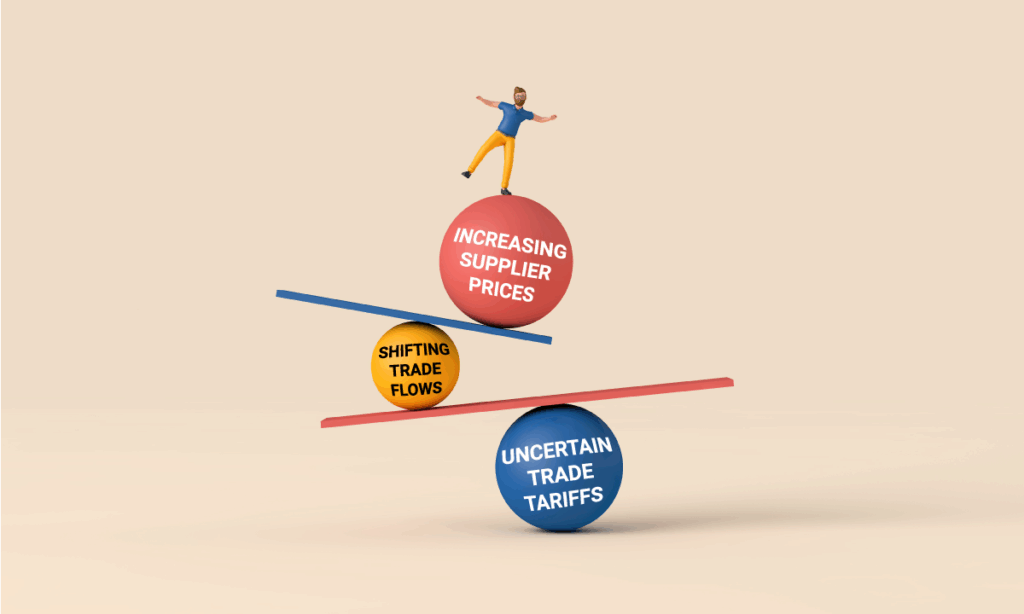
[Editor’s Note: Today’s article is a guest post from Market Dojo, a technology company offering Software as a Service built by procurement professionals, for procurement professionals. Its solutions enable procurement to overcome the challenges they face through managing data, mitigating risk, and minimizing costs. If you or someone you know would like to make a guest contribution, please contact us at editor at cporising dot com. Thanks!]
U.S. tariffs and associated trade disruptions in 2025 have led to the highest effective tariff rates in nearly a century, increasing consumer prices, reducing GDP growth, and significantly shifting trade flows.
How Tariffs and Uncertainty Are Disrupting Global Trade
While some sectors like manufacturing have seen modest gains, the broader implications (e.g., economic contraction, job losses, and higher costs for households — especially those with lower incomes) loom high.
Whether we’re witnessing a “new world order” is yet to be decided, but what is certain is that the global impact includes declining trade volumes and heightened risks for vulnerable economies. The effects of this uncertainty are evident in the data points and projections listed below.
This environment, marked by constant delays, adjustments, and mixed signals about “reciprocal” tariffs, is generating pervasive uncertainty. If your procurement strategy relies on yesterday’s methods, you’re likely already feeling the pressure.
| Impact of Uncertain U.S. Tariffs on Global Trade
● The average effective U.S. tariff rate is currently at levels not seen in decades and is projected to settle significantly higher than baselines (source). ● Under several modeled trade negotiation scenarios, direct trade between the U.S. and China could decline by up to 90% (source). ● Major U.S. ports are sounding alarms about precipitous drops in import volumes (source). This means firms are expecting shortages or delays in getting products delivered, potentially impacting availability for end customers globally (source). ● It’s not just imports. U.S. exports are projected to be 15.5–18.1% lower in the long run (source). Nearly 7 in 10 (68%) of heads of payments at U.S. goods firms anticipate difficulty exporting due to retaliatory measures by other countries (source). Indeed, 76% of retailers outside the U.S. are saying they are not going to shop U.S. brands. This is “not what was intended with these tariffs,” says Kristin Savilia, CEO at Joor, a digital wholesale platform that connects fashion brands and retailers (source). ● The World Trade Organization (WTO) forecasts a 0.2% decline in global merchandise trade in 2025. If trade tensions escalate further, this decline could reach 1.5%. North American exports are specifically projected to drop by 12.6% (source). Vulnerable and export-dependent economies are particularly hard hit by this slowdown (source). ● Global businesses are already seeing impacts. LVMH, a luxury goods giant, saw a global sales dip (source). Maersk, a bellwether for global trade shipping 20% of the world’s container volumes, warned that trade could decline this year, revising its growth projections. According to Maersk CEO Vincent Clerc, trade volumes between the United States and China fell between 30% and 40% in April due to the tariffs (source). |
Procurement Must Respond to This New Kind of Risk
Beyond the direct trade policies, tariffs are causing significant supply chain strain.
Most middle-market firms expect disruptions, from higher raw material costs to shipping delays and shortages. Even services firms, which rely less on direct imports, widely expect higher material costs and product delays or shortages, highlighting the complex and interconnected nature of today’s businesses and their supply chains.
The challenge is that tariffs aren’t like typical procurement risks. Instead, they are:
- Fast and volatile, often changing suddenly based on political decisions
- Government-driven, making them harder to influence or mitigate directly compared to operational issues
- Marked by regulatory complexity, requiring specialized knowledge in legal and compliance areas
- Have a direct financial impact, instantly raising the cost of imported goods and leading to margin compression
- Often trigger a strategic reassessment, forcing companies to rethink sourcing locations, suppliers, or even product design
- Create broad supply chain ripple effects, impacting multiple tiers.
While a “wait and see” approach may seem tempting, the ongoing policy uncertainty is already undermining both business confidence and consumer sentiment. As Kristin Savilia, CEO at Joor, put it, “Uncertainty kills economies.”
Decisive Actions Are Emerging Across Sectors
According to the 2025 Certainty Project by PYMNTS Intelligence, some companies still lack confidence about how to respond to the fast-moving and unpredictable tariff situation, or have taken no action — 16% for goods and 24% for services.
However, many companies are taking decisive action to mitigate disruption. For goods firms, the most common responses are to:
- Renegotiate pricing with existing suppliers (63%)
- Replace overseas providers with domestic ones (53%)
- Diversify their international suppliers (26%)
- Stockpile inventory before certain levies kick in (37%).
Services providers, plan to:
- Reduce operational costs (75%). This likely means cutting jobs in many cases, as workers are typically the largest cost for services firms
- Renegotiate with their existing suppliers (48%)
- Diversify international providers (53%)
- Switch to domestic suppliers (18%).
What’s clear is that the size of the task is huge for many companies. Rerouting supply chains is not only costly but operationally near impossible in the short term. Given that global networks have been built over decades, any major reconfiguration could take many years — potentially a decade or more.
Outdated Procurement Processes Are No Longer Sustainable
It’s important to face this unique, unpredictable, and urgent challenge with all the tools available to you. Manual processes simply will not keep pace. Relying on spreadsheets and email-based communication to manage tenders and suppliers leads to slow response times, limited visibility, and a reactive approach. In contrast, eSourcing tools enable a faster, more strategic procurement process — improving transparency, accelerating decision-making, and helping businesses adapt quickly to shifting market conditions.
Part of that adaptability includes rethinking your supplier network. Companies must diversify their supplier base rather than rely on the same few sources. Supplier discovery tools make it easier to pivot your sourcing strategy, explore global territories, and secure more competitive rates — much like Apple’s strategic shift from China to India.
Procurement must respond to tariff uncertainty with both speed and strategic precision — something that’s simply not possible with outdated processes.
The answer lies in embracing new digital tools.
Digital Tools Offer a Strategic Advantage
Market Dojo is a firm believer that Procurement shifts from a reactive back-office function to a proactive strategic department focused on value creation for the entire organization. Visit our Sourcing Excellence Hub for best practice guides, videos, and resources based on your procure-tech maturity.
New eSourcing solutions offer a data-driven, agile alternative to traditional static procurement systems. Unlike legacy tools that require heavy investment and lack adaptability, the new breed of platforms is designed to evolve with market demands — helping you respond quickly to volatility, prevent unjustified pre-emptive price increases, and negotiate fair, transparent adjustments.
These tools help you:
- Accelerate competitive bidding through e-auctions to challenge inflated pricing
- Implement ‘tariff contingency’ contract clauses for transparency and protection
- Diversify supply sources across trade zones using supplier discovery tools
- Leverage advanced analytics to model tariff impacts accurately
- Evaluate strategic shifts like reshoring and nearshoring with robust cost analysis.
Want the full playbook on how to tackle tariff-driven supplier price increases with digital procurement?
Download Market Dojo’s Navigating Trade Disruptions eGuide.