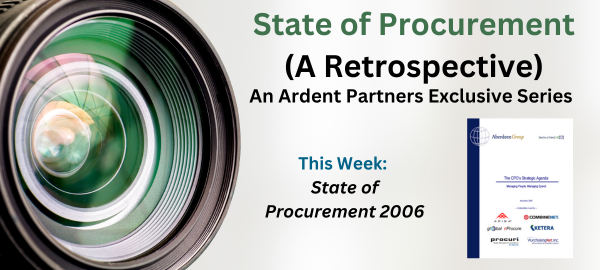
The role and strategic agenda of the chief procurement officer (CPO) have evolved over the past decade. In a new weekly series from Ardent Partners, we revisit what defined procurement and the CPO’s agenda based on responses to Ardent’s annual State of Procurement Report. The series begins at the beginning in 2006, the inaugural year Andrew Bartolini, founder and chief research officer for Ardent, launched the State of Procurement Report.
Each week, we will outline the key procurement insights for the next year in this series, culminating in 2025.
The Evolving Strategic Role of the CPO: Insights from the 2006 Agenda
In November 2006, the procurement landscape was undergoing a critical shift — one marked by a growing recognition of its strategic importance within the enterprise. The report titled The CPO’s Strategic Agenda 2006 – Managing Spend, Managing People captured this moment of transformation, revealing how chief procurement officers (CPOs) were increasingly stepping into roles that extended well beyond transactional duties. With 89% of survey respondents affirming that procurement had become more strategic over the past three years, the momentum was clearly in favor of an elevated procurement function. Yet, the path to strategic influence was, and still is, a complex journey, filled with organizational, operational, and technological challenges.
Human capital critical to procurement success. One of the most telling insights from the report centered on the organization and structure of procurement teams. For top-performing CPOs, the priority was clear: people. Recruiting, training, retaining, and aligning procurement talent emerged as the number one goal. This focus on human capital underscores a broader understanding that the success of procurement strategies hinges not just on systems or spend analytics but on the capabilities and cohesion of the team executing them. Building high-performing procurement teams wasn’t just about filling roles — it was about creating a workforce aligned with business objectives, empowered to innovate, and equipped to drive measurable value.
Drive for compliance and spend under management. Another dominant theme from the research was the drive to increase spend under management and compliance. This objective was cited as the top goal across all procurement organizations, regardless of performance level. However, it’s notable that among Best-in-Class enterprises — those identified as leaders in procurement performance — this goal ranked lower within their top ten priorities. This contrast suggests that while controlling spend is a foundational procurement objective, the most mature organizations have already achieved a level of control and compliance that allows them to shift focus toward more strategic pursuits such as supplier innovation, category management, and value creation.
Supplier strategies are a priority. Indeed, supplier-related strategies — including development, rationalization, and collaboration — were ranked highly across the board, and particularly so among Best-in-Class organizations. As companies looked to build more resilient and value-generating supply chains, it became increasingly important to move beyond price-based vendor relationships and toward strategic supplier partnerships. Supplier development programs and rationalization initiatives were gaining traction as companies sought to reduce risk, increase innovation, and improve service levels from a more streamlined and collaborative supplier base.
Automation a focal point with important choices. Technology, as expected, also featured prominently in the CPO’s agenda. The drive for technology-enabled procurement placed automation and digital tools firmly within the top ten goals for procurement leaders. However, a key point of divergence among CPOs was the choice between best-of-breed solutions and broad, integrated suites. Opinions were evenly split. This divide highlighted a fundamental tension that still exists in many organizations: whether to deploy highly specialized tools tailored to specific functions or to adopt integrated platforms that promote consistency and scale across the enterprise. Each approach offers distinct benefits, and the decision often comes down to organizational culture, size, and digital maturity.
Procurement’s Struggle to Earn a Seat at the Table
Despite these advancements, procurement remained in a somewhat paradoxical position — central to enterprise operations, yet often relegated to the periphery in terms of strategic recognition. The report observed that procurement touches nearly every part of an organization, playing a crucial role in buying goods and services — the very lifeblood of any business. Still, it had not yet fully earned the same strategic stature as functions like sales, which are almost universally regarded as core to business success. This disparity was underscored by the fact that, on average, only 19% of CPOs reported directly to the president or CEO, compared to 27% in Best-in-Class organizations. The data revealed a continuing struggle for procurement to secure a seat at the executive table.
Nevertheless, the report struck a hopeful tone. The fact that nearly 90% of respondents acknowledged procurement’s growing strategic role signaled a shift in perception and practice. Procurement was no longer simply a cost-control function; it was becoming a hub of intelligence, risk mitigation, and innovation. The journey toward full strategic integration was not complete, but clear progress was being made.
In conclusion, The CPO’s Strategic Agenda 2006 offered a timely snapshot of a function in transition. With people, process, and technology as guiding pillars, procurement was on the rise. While challenges remained — particularly in gaining organizational visibility and executive alignment — the foundation for a strategic procurement function was being firmly laid. The report not only reflected the aspirations of procurement leaders at the time but also anticipated the continued evolution of the function in the decades to follow.